
Slack Workspace
The Slack Workspace notification service is the recommended way to send Buildkite Pipelines build notifications to Slack. It requires a single, once-off configuration per Slack workspace, after which any pipeline can use the notify attribute in its pipeline.yml to post messages to any channel or user in that workspace.
Migrate from the legacy Slack notification service
If you are still using one or more individual Slack (legacy) notification services—where each service is bound to a single channel or user—Buildkite recommends migrating to the Slack Workspace notification service. The Slack Workspace notification service offers a simpler configuration experience and additional features such as the pipeline.started_failing and pipeline.started_passing conditionals.
Connect Slack workspace
The Slack Workspace integration lets you receive notifications in your Slack workspace. This integration supports:
Adding a Slack Workspace notification service will authorize access for your entire Slack app for a given Slack workspace. You only need to set up this integration once per Slack workspace, after which, you can then configure notifications to be sent to any Slack channels or users.
Setting up a Workspace requires Buildkite organization admin access.
Select Settings in the global navigation and select Notification Services in the left sidebar.
-
Select the Add button on Slack Workspace.

-
Select the Add to Slack button:
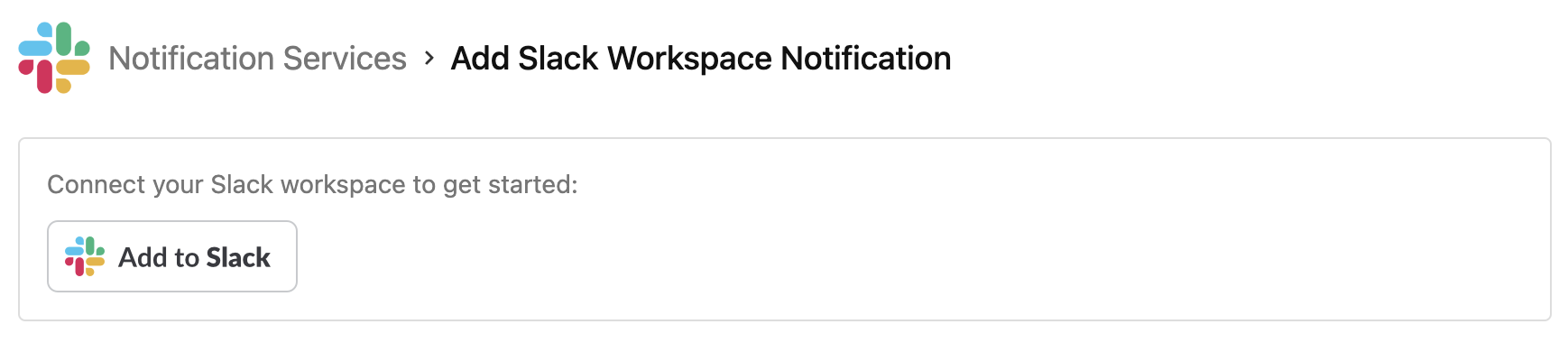
This action redirects you to Slack.
Log in to Slack and grant Buildkite permission to post across your workspace.
After granting access, you can then configure Pipeline build notifications and Test Engine workflow Slack notifications.
Configuring notifications
Once the Slack workspace is connected, use the notify attribute in your pipeline.yml to configure specific notifications:
notify:
  - slack:
      channels:
        - "buildkite-community#general"
        - "buildkite-community#announcements"
If your organization has more than one Slack Workspace integration, prefix Slack IDs in build-level notifications with the workspace slug (workspace-slug@ID, workspace-slug#channel-name). You can find the slug on the Slack Workspace integration's settings page, which you can access from your Buildkite organization's Notification Services settings.
Mentions in build notifications
The build's author is mentioned automatically when the build can be linked to a Buildkite user and that user's verified email matches the email on their Slack account. A build is linked to a Buildkite user when the email of the commit's Git author matches a verified Buildkite email or when the commit's source control user matches a connected account of a Buildkite user (managed under Personal Settings > Connected Apps). Both the Buildkite user and their Slack account must be in the connected organization and workspace.
If a contributor commits with their actual email address hidden and a placeholder address like 12345+username@users.noreply.github.com is used, that address cannot be added as a verified Buildkite email (verification emails to it bounce). You need to connect a GitHub account under Personal Settings > Connected Apps in Buildkite to enable automatic mentions for that contributor.
To mention a specific Slack user explicitly, provide their Slack user ID, which you can access from User > More options > Copy member ID.
notify:
  - slack: "U123ABC456"
Notify in private channels
You can notify individuals in private channels by inviting the Buildkite Builds Slack app into the channel with /invite @Buildkite Builds.
Build-level notifications:
notify:
  # Notify private channel
  - slack: "buildkite-community#private-channel"
You can also use a channel ID (prefixed with an uppercase C) to target a private channel. Channel IDs are more stable than names as they remain valid if the channel is renamed. See Notify using a Slack channel or conversation ID for details.
Conditional notifications
Use the notify YAML attribute in your pipeline.yml file to configure conditional notifications.
See the Slack channel message section of the Notifications guide for the configuration information.
Conditional notifications with pipeline states
You can control conditional notifications using pipeline.started_passing and pipeline.started_failing in the if attribute of the notify key of your pipeline.yml. Previously, these notification rules were configured in the user interface of the Slack (legacy) notification service.
See Conditional Slack notifications for more examples.
Customizing notifications
The following sections are a collection of how-tos for customizing Slack notifications in Buildkite Pipelines. Each section addresses a specific use case independently. Pick the ones that match your needs and combine the relevant notify attributes into your own pipeline.yml. The use cases are not designed to be applied all at once.
The how-tos cover:
- Sending a Slack message on build failure.
- Mentioning the pull request creator or the user who unblocked a build.
- Restricting notifications to specific failure scenarios using conditionals.
- Combining multiple notification rules to route different events to different channels.
- Posting notifications from dynamically generated steps.
- Guaranteeing that a final notification step runs regardless of build outcome.
For the full reference of notify attributes and conditionals, see Triggering notifications and Conditionals.
Send a Slack message on build failure
The simplest way to notify a Slack channel when a build fails is to add a build-level notify attribute that uses the if conditional to match failed builds.
Add the following to your pipeline.yml:
notify:
  - slack: "buildkite-community#builds"
    if: build.state == "failed"

steps:
  - label: "Tests"
    command: "npm test"
This sends a notification to the #builds channel in the buildkite-community workspace whenever a build finishes in the failed state. Replace the workspace and channel name with values that match your own Slack workspace.
When using only a channel name, you must specify this name in quotes. Otherwise, the # causes the channel name to be treated as a YAML comment.
Mention the pull request creator
To draw the attention of the user who opened the pull request, include a Slack user mention in a custom message. Slack mentions use the <@user-id> syntax, where user-id is the Slack user ID of the person to mention. See the Slack documentation on mentioning users for how to find a particular user's ID.
The following example posts a custom message to #builds and mentions a specific Slack user when the build fails:
notify:
  - slack:
      channels:
        - "buildkite-community#builds"
      message: "Build failed for `${BUILDKITE_BRANCH}` <@U018FG***>, please take a look."
    if: build.state == "failed"
Build creator environment variable
You cannot substitute a Slack user mention with the build creator environment variable value directly. To dynamically mention the user who created the build, maintain a mapping from Buildkite user identifiers (such as build.creator.email or build.creator.id) to Slack user IDs in your build script, then use annotations or a dynamic pipeline step to upload a notify block that includes the resolved Slack user ID.
For an overview of available build creator and author variables, see Supported variables.
Dynamically mention the build creator
To mention the build creator at runtime, generate the notify block from a script that translates the Buildkite creator email or ID into the corresponding Slack user ID, then upload the result using buildkite-agent pipeline upload.
The following example uses a pre-command step to look up the Slack user ID and emit a dynamic pipeline:
steps:
  - label: "Tests"
    command: "npm test"
  - wait: ~
    continue_on_failure: true
  - label: "<img class="emoji" title="slack" alt=":slack:" src="https://buildkiteassets.com/emojis/img-buildkite-64/slack.png" draggable="false" /> Notify creator on failure"
    command: ".buildkite/notify-creator.sh | buildkite-agent pipeline upload"
The example notify-creator.sh script below reads BUILDKITE_BUILD_CREATOR_EMAIL from the environment, calls Slack's users.lookupByEmail API to resolve the email to a Slack user ID, and emits a YAML pipeline fragment containing a notify attribute with the <@user-id> mention. This avoids maintaining a separate email-to-user-ID map.
The script needs a Slack bot token with the users:read.email scope. Store the token as a secret and expose it to the script as the SLACK_BOT_TOKEN environment variable:
#!/usr/bin/env bash
set -euo pipefail

email="${BUILDKITE_BUILD_CREATOR_EMAIL:-}"
token="${SLACK_BOT_TOKEN:-}"

if [[ -z "$email" || -z "$token" ]]; then
  echo "Email or Slack bot token is not set; skipping creator mention." >&2
  exit 0
fi

slack_user_id=$(curl --silent --get \
  --data-urlencode "email=$email" \
  --header "Authorization: Bearer $token" \
  https://slack.com/api/users.lookupByEmail \
  | jq -r 'select(.ok) | .user.id')

if [[ -z "$slack_user_id" ]]; then
  echo "No Slack user found for $email; skipping creator mention." >&2
  exit 0
fi

cat <<EOF
notify:
  - slack:
      channels:
        - "buildkite-community#builds"
      message: "Build #\${BUILDKITE_BUILD_NUMBER} failed. <@$slack_user_id>, please take a look."
    if: build.state == "failed"
EOF
The \${BUILDKITE_BUILD_NUMBER} reference uses a backslash to escape the variable so the shell does not interpolate it at script runtime. The agent interpolates it when it processes the uploaded pipeline. The $slack_user_id reference is interpolated by the shell so the resolved Slack user ID is baked into the uploaded YAML.
If provisioning a Slack bot token is not viable, replace the curl call with a jq lookup against a JSON map file (for example, .buildkite/slack-user-map.json) checked into the repository.
For more on generating pipeline configuration at runtime, see Dynamic pipelines.
Send a Slack direct message to the user who triggered the build
You cannot supply environment variables or build meta-data directly to the notify attribute. To send a Slack direct message (DM) to the user who triggered the build—on events such as build started, discovery finished, a test failure, or build finished—use a dynamic pipeline upload that interpolates the resolved Slack user ID into a generated notify block.
The following example uses a shell <<EOF here document to upload a step whose notify attribute references a SLACK_USER_ID environment variable. Set SLACK_USER_ID earlier in the build (for example, by mapping BUILDKITE_BUILD_CREATOR_EMAIL to a Slack user ID in a hook or a preceding step):
steps:
  - label: "<img class="emoji" title="slack" alt=":slack:" src="https://buildkiteassets.com/emojis/img-buildkite-64/slack.png" draggable="false" /> Notify triggering user"
    command: |
      buildkite-agent pipeline upload <<EOF
      steps:
        - command: "echo 'Notifying user...'"
          notify:
            - slack:
                channels:
                  - "${SLACK_USER_ID}"
                message: |
                  Your custom message here.
      EOF
Repeat this pattern at different points in the pipeline to send a DM on each event of interest, such as discovery finishing, a specific test failing, or the build completing. Use if conditionals on the generated step to fire the DM only when the corresponding outcome occurs.
Mention the user who unblocked a build
The BUILDKITE_UNBLOCKER environment variable is only set after a block step is unblocked, so it cannot be resolved at the time the initial pipeline.yml is uploaded. To include the unblocker's name in a Slack message, add a step after the block step that uploads a dynamic pipeline fragment containing the notify attribute. Escape the variable with $$ so the agent passes it through to the uploaded pipeline, where it is resolved at runtime:
steps:
  - block: "⚠️ Unblock this pipeline"

  - label: "<img class="emoji" title="slack" alt=":slack:" src="https://buildkiteassets.com/emojis/img-buildkite-64/slack.png" draggable="false" /> Unblocker notification"
    command: |
      buildkite-agent pipeline upload <<EOF
      notify:
        - slack:
            channels:
              - "buildkite-community#builds"
            message: '$$BUILDKITE_UNBLOCKER has unblocked the pipeline.'
      EOF

  - label: "Build"
    command: "make build"
The same pattern works for the related BUILDKITE_UNBLOCKER_EMAIL, BUILDKITE_UNBLOCKER_ID, and BUILDKITE_UNBLOCKER_TEAMS variables. To mention the unblocker as a Slack user instead of including their name, map BUILDKITE_UNBLOCKER_EMAIL to a Slack user ID using the same approach described in Dynamically mention the build creator.
Notify only specific failure scenarios
By default, restricting notifications to build.state == "failed" only sends one notification per failed build. The following sections show how to refine that behavior for common scenarios. For the full list of supported conditionals (including patterns such as "all failures and first successful pass"), see Conditional Slack notifications in the notify reference.
Notify on first failure only
If a pipeline fails repeatedly, you might not want a notification for every failed build. The pipeline.started_failing conditional sends a notification only when a pipeline transitions from a passing state to a failing state:
notify:
  - slack:
      channels:
        - "buildkite-community#builds"
      message: "🚨 `${BUILDKITE_PIPELINE_SLUG}` started failing on `main`."
    if: build.branch == "main" && pipeline.started_failing
Limiting by consecutive failures
Buildkite Pipelines supports limiting Slack notifications to the first failure (pipeline.started_failing) and to the first pass after a failure (pipeline.started_passing). There is no built-in conditional for triggering a notification only after N consecutive failed or passed builds.If you have configured automatic job retries, one workaround is to use a post-command or pre-exit hook to perform a dynamic buildkite-agent pipeline upload of a command step that posts a Slack notification once BUILDKITE_RETRY_COUNT reaches a threshold. This approach checks consecutive failures at the job level rather than the build level.
Notify when a previously failing build passes
To follow up the previous notification with confirmation that the pipeline has recovered, use the pipeline.started_passing conditional:
notify:
  - slack:
      channels:
        - "buildkite-community#builds"
      message: "✅ `${BUILDKITE_PIPELINE_SLUG}` is back to passing on `main`."
    if: build.branch == "main" && pipeline.started_passing
Notify on pull request branches only
To restrict failure notifications to pull request builds, combine build.state and build.pull_request.id:
notify:
  - slack:
      channels:
        - "buildkite-community#pr-failures"
      message: "Build #${BUILDKITE_BUILD_NUMBER} for PR #${BUILDKITE_PULL_REQUEST} failed."
    if: build.state == "failed" && build.pull_request.id != null
This pattern is useful for separating noisy main branch notifications from focused per-pull-request alerts.
Notify when a specific step fails
To send a Slack message immediately when a single step fails, attach a step-level notify attribute and use the step.outcome conditional:
steps:
  - label: "Integration tests"
    command: "./scripts/integration-tests.sh"
    notify:
      - slack:
          channels:
            - "buildkite-community#qa"
          message: "Integration tests failed in build #${BUILDKITE_BUILD_NUMBER}."
        if: step.outcome == "hard_failed"
Build-state conditionals are build-level only
Build-state conditionals (build.state) cannot be used on step-level notifications, since a step cannot know the state of the entire build.
Notify on soft-failed steps
A soft-failed step does not fail the overall build, but you might still want a Slack message to record the event:
steps:
  - label: "Lint"
    command: "./scripts/lint.sh"
    soft_fail: true
    notify:
      - slack:
          channels:
            - "buildkite-community#builds"
          message: "Lint reported issues but the build continued."
        if: step.outcome == "soft_failed"
Combine multiple notification rules
You can declare more than one notify entry to route different events to different channels. The following example notifies a broad team channel on the first failure, mentions a specific on-call user for main branch failures, and sends per-pull-request alerts to a separate channel:
notify:
  - slack:
      channels:
        - "buildkite-community#builds"
      message: "🚨 `${BUILDKITE_PIPELINE_SLUG}` started failing."
    if: build.branch == "main" && pipeline.started_failing
  - slack:
      channels:
        - "buildkite-community#oncall"
      message: "On-call <@U045GK***>, the `main` branch build failed."
    if: build.branch == "main" && build.state == "failed"
  - slack:
      channels:
        - "buildkite-community#pr-failures"
      message: "PR #${BUILDKITE_PULL_REQUEST} build failed: ${BUILDKITE_BUILD_URL}"
    if: build.state == "failed" && build.pull_request.id != null

steps:
  - label: "Tests"
    command: "npm test"
Each entry is evaluated independently, so a single failed build can trigger more than one of these messages.
Notifications in dynamic pipelines
Build-level notify in your initial pipeline.yml covers the whole build, including any steps added by buildkite-agent pipeline upload. You do not need to repeat the build-level notify in each uploaded fragment.
Step-level notify is different. To send a notification when a specific generated step fails, your generator script must include notify on that step as it is not inherited from the initial pipeline.yml. Only Slack, GitHub checks, GitHub commit statuses, and Basecamp are available at step level. Email, PagerDuty, and webhook notifications are build-level only, so configure those in the initial pipeline.yml.
The following example shows a generated step that posts to Slack when it hard-fails:
steps:
  - label: "🚀 Deploy to production"
    command: "make deploy"
    notify:
      - slack:
          channels:
            - "buildkite-community#deploys"
          message: "Production deploy failed."
        if: step.outcome == "hard_failed"
Post a final Slack summary after dynamically generated steps
When earlier steps in a build use buildkite-agent pipeline upload to generate more steps, you might want a final step that waits for everything to finish and then posts a Slack summary. To make the final step wait for the generated steps, declare the upload steps, the wait, and the summary step together in a single parent pipeline.yml.
The following parent pipeline runs two steps that each generate and upload more steps, waits for all uploaded steps to complete, then runs a validation step that posts a Slack message:
steps:
  - label: "Part 1"
    command: ".buildkite/generate-part1.sh | buildkite-agent pipeline upload"

  - label: "Part 2"
    command: ".buildkite/generate-part2.sh | buildkite-agent pipeline upload"

  - wait

  - label: "✅ Validation"
    command: ".buildkite/validate.sh"
    notify:
      - slack:
          channels:
            - "buildkite-community#builds"
          message: "Build #${BUILDKITE_BUILD_NUMBER} validation summary posted."
        if: step.outcome == "passed" || step.outcome == "hard_failed"
Each Part N step can upload as many steps as needed. Because the wait and the validation step are declared in the parent pipeline.yml, the validation step only runs after every uploaded step has finished. Keep the wait and the final summary step at the end of the parent pipeline so the summary always runs after everything else, regardless of how many chunked upload steps precede them.
Guarantee a final Slack notification runs
If an earlier step hard-fails, Buildkite Pipelines does not run subsequent steps in the build, so a trailing Slack notification step never executes. The following patterns ensure a final notification always runs and can report on the overall outcome.
Use a wait step that continues on failure
Place a wait step with continue_on_failure: true before the final notification step so the notification step still runs even if earlier steps hard-fail. From the notification step's command, use buildkite-agent step get state --step <key> to inspect the outcome of a specific earlier step, identified by its key (or by BUILDKITE_STEP_ID for the current step). This is more reliable than depending on the overall build state:
steps:
  - label: "Tests"
    key: "tests"
    command: "npm test"

  - wait: ~
    continue_on_failure: true

  - label: "<img class="emoji" title="slack" alt=":slack:" src="https://buildkiteassets.com/emojis/img-buildkite-64/slack.png" draggable="false" /> Final report"
    command: |
      tests_state=$(buildkite-agent step get state --step tests)
      echo "Tests step finished with state: $tests_state"
    notify:
      - slack:
          channels:
            - "buildkite-community#builds"
          message: "Build #${BUILDKITE_BUILD_NUMBER} finished. Check the final report step for per-step outcomes."
If you prefer subsequent steps to keep running without wait and continue_on_failure, mark the earlier steps with soft_fail. Soft-failed steps do not stop the build, so a downstream notification step runs normally.
Send notifications from a job hook
For notifications that should fire after every job, not just at the end of the build, use a post-command or pre-exit agent hook. The post-command hook runs immediately after each step's command, and pre-exit runs just before the job ends. Both have access to the job's exit status and the BUILDKITE_* environment variables, so a shell script can call the Slack API directly without adding any steps to pipeline.yml. This approach is best when the same notification logic should apply across many pipelines or jobs.
Wrap pipeline upload to inject a final step
To enforce a final Slack notification across every pipeline in your organization without per-pipeline configuration, wrap buildkite-agent pipeline upload with a script. The wrapper reads the YAML being uploaded, appends a wait step with continue_on_failure: true followed by the notification step, then forwards the modified YAML to the real buildkite-agent pipeline upload. Invoke the wrapper from an agent hook so it intercepts every upload automatically.
A wrapper around buildkite-agent pipeline upload is powerful but adds operational complexity. The wrapper must handle YAML parsing, error cases, and pipelines that already include their own final notification step, and it can be difficult to debug when something goes wrong. Reserve this approach for environments where consistent end-of-build behavior is mandatory and per-pipeline configuration is not viable.
Verify your notifications
After applying any of the how-tos above, confirm the resulting notifications behave as expected:
- Commit and push your
pipeline.ymlchanges to a branch. - Trigger a build that exercises the scenario you configured. For failure-related conditionals, this might mean introducing a failing test; for unblocker mentions, this means unblocking a block step; for
pipeline.started_passing, this means pushing a fix after a previous failure. - Confirm that the configured Slack channels receive the expected messages, and that any user mentions resolve to the correct Slack users.
If a notification does not arrive, check the following:
- The Slack workspace is connected and the relevant pipeline is included in the workspace's notification settings.
- The Slack channel exists and the Buildkite Builds Slack app has been invited to it.
- The
ifexpression matches the build state at the moment the notification event fires. See Supported variables for the full list of conditionals.
Privacy policy
For details on how Buildkite handles your information, please see Buildkite's Privacy Policy.
Next steps
- Read more about the
notifyattribute for the full reference of supported notification targets and conditional patterns. - Combine Slack notifications with build annotations to share rich context, such as failing test output, alongside each Slack message.