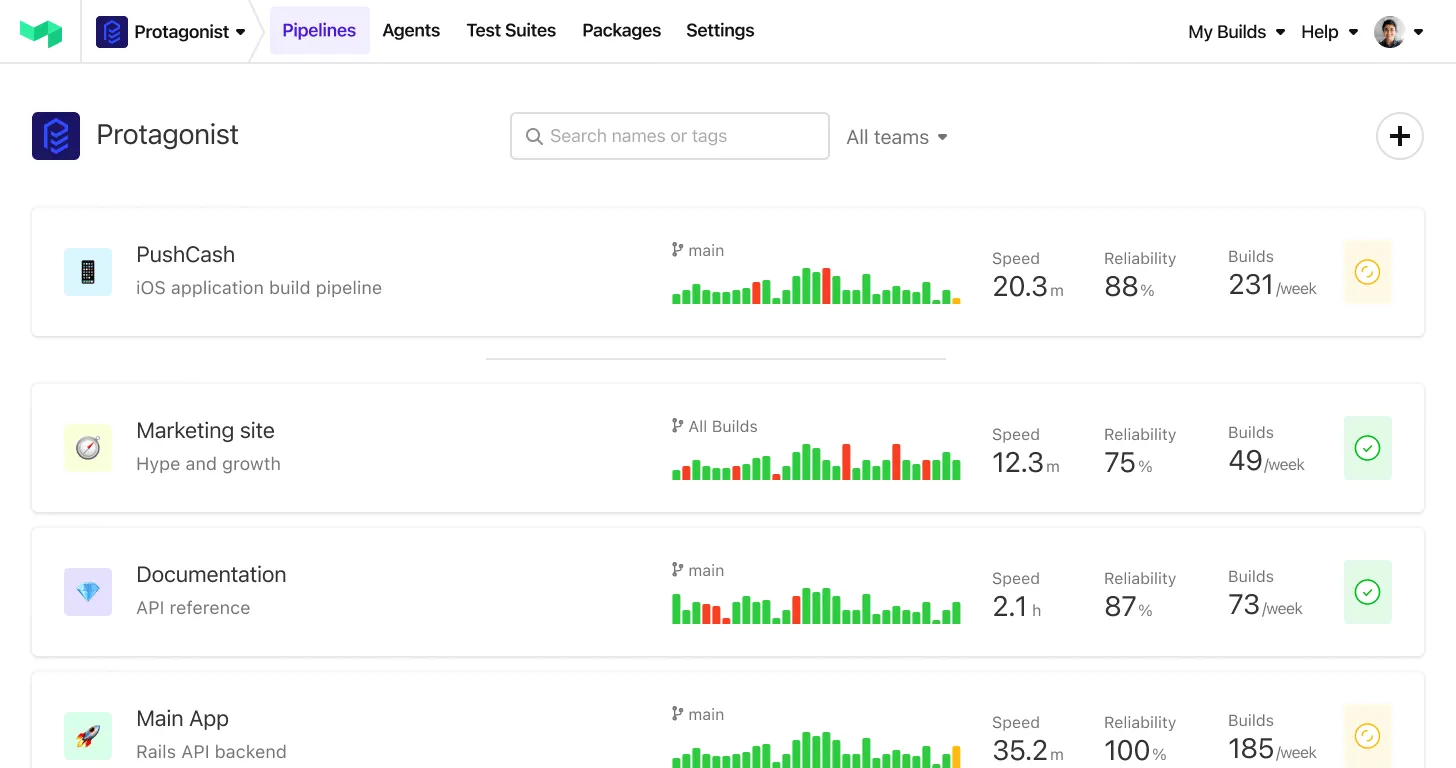
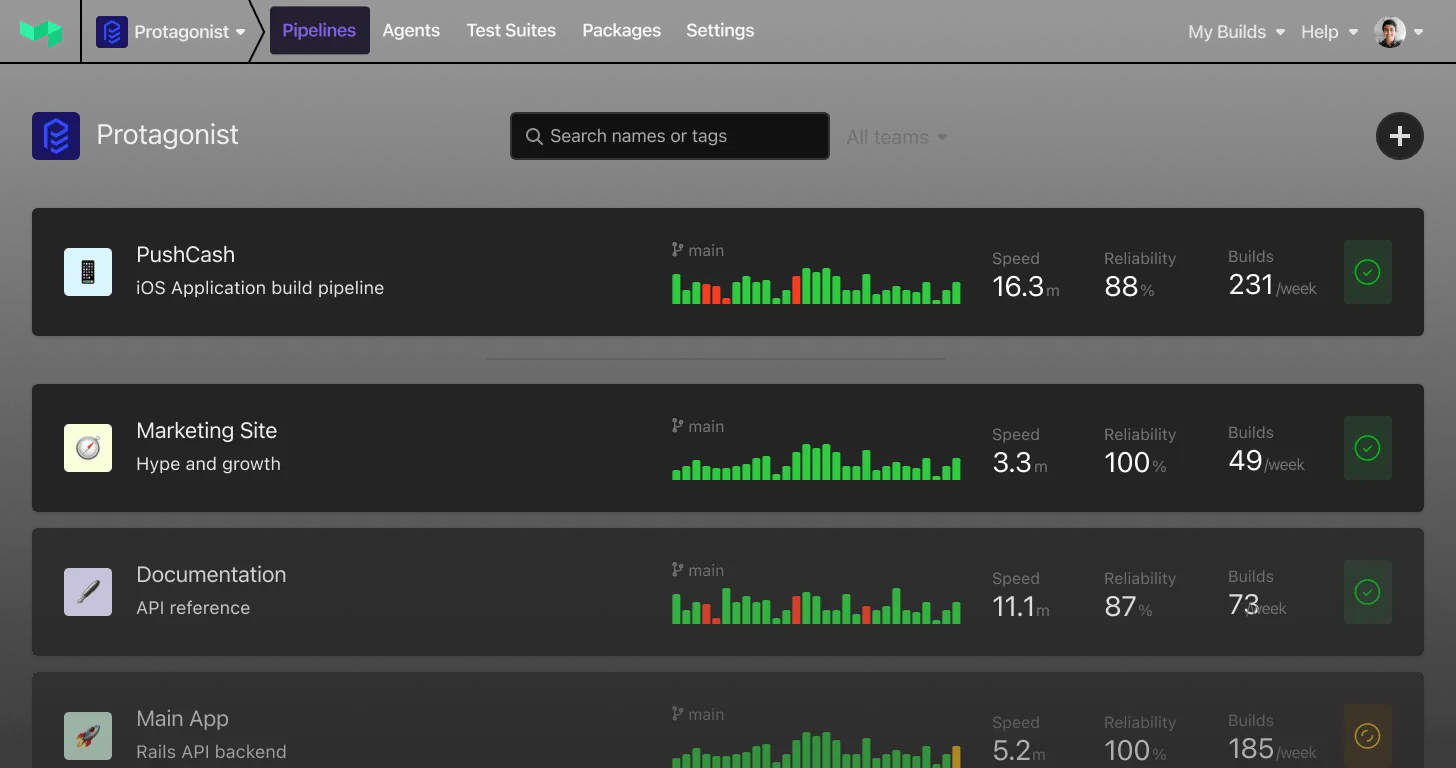
Buildkite vs GitHub Actions
GitHub Actions is built so you never have to set up CI. Buildkite is built so you can.
Most teams use the default. And for most, it works. The question is different: should your CI be designed? If so, Buildkite is the answer. Your compute, your pipeline logic, your test intelligence, and a bill that makes sense.
- Choose Buildkite: when CI is the backbone for building software at any scale.
- Choose GitHub Actions: zero setup, repo native, when all you need is the default.
The short version
What Buildkite is built for
- Compute you choose: your infra, Buildkite’s, or both
- Generate pipeline steps at runtime, not ahead of time
- Keep test intelligence in the platform, not bolted on
- Pin a small supply chain to agents you control
- Start free, with dynamic pipelines and test intelligence included
What GitHub Actions is good at
- Zero setup, native to GitHub
- The largest workflow extension marketplace
- Free minutes on every plan, unlimited on public repos with standard runners
- Nothing to set up, nothing to own
Feature comparison
By capability, not bias. Where GitHub Actions is the better choice, we say so.
| Capability | Buildkite | GitHub Actions |
|---|---|---|
| Setup and first build | Connect a repo, define pipeline steps, point agents at it, or use hosted compute. Setup is deliberate; the design is the product. | Commit a YAML file. No infrastructure decisions to make. |
| Compute and execution | Your infrastructure, Buildkite’s hosted compute, or both. Support Linux, macOS (M4), Windows, GPU and ARM. Change the compute model without rewriting pipelines. | GitHub-hosted and self-hosted runners. Native to GitHub, nothing to stand up. |
| Scale and concurrency | Self-hosted agents you provision.
| Concurrent jobs capped by plan
|
| Orchestration and dynamic pipelines | Pipeline steps generated at runtime in Go, Python or Bash, so the build adapts to the commit. Included in every plan. | YAML matrix builds and reusable workflows. Static config, written ahead of time, not generated. |
| Test intelligence | Test splitting by timing, flaky detection and ownership mapped to teams on every plan.
| No native splitting, flaky detection or quarantine. Integrate with Knapsack or Currents. |
| Artifacts and registries | Artifact storage and transfer of 50GB and 250GB/month on Free, 250GB and 2.5TB on Pro. Package and container registries in the same platform — 1GB/month on Free, 20GB on Pro (pricing). | GitHub Packages, native to the repo, no new investment. Artifact and cache storage billed. |
| Governance and security | SOC 2 Type II on every plan. SSO and signed pipelines from Pro; SCIM, custom SAML, audit log exports and private log storage on Enterprise. | SOC 2 Type II, ISO/IEC 27001:2022, FedRAMP Tailored (Low). SSO and SCIM on Enterprise. Marketplace actions run as third-party code in your pipeline - pin to commit SHAs. |
| Ecosystem and supply chain | A small plugin set you pin, running on agents you control. | The largest marketplace, and it covers almost everything. |
| Reliability and ownership | Choose the infrastructure agents run on and we'll handle the control plane. They're open source and built to go anywhere. 99.95% platform uptime commitment for Enterprise. View SLA → | GitHub schedules, reports and stores every job, hosted or self-hosted. Per-component status published publicly. |
| Pricing model |
| Per seat plus per build minute - Linux $0.006/min, Windows $0.010/min, macOS $0.062/min. Free minutes on every plan; unlimited on public repos, standard runners only See Billing ↗ |
Bring your GitHub Actions workflows to Buildkite
Teams stay on GitHub Actions longer than they want for one reason: moving is costly. The GitHub Actions Buildkite plugin removes that cost. Open source, MIT-licensed, and now in public preview. Point it at your existing .github/workflows file and it runs in Buildkite unchanged. No GitHub Actions run created, nothing written back to your repo.
Check the compatibility matrix to see what's currently supported.
Why the setup matters
GitHub Actions requires zero setup decisions. Buildkite requires a few and those choices hold as your build volume grows.
Run agents on your own infrastructure. Your cloud account, your Macs, your GPUs, inside your network. Source and secrets never leave it. Change the compute model without touching a single pipeline.
Generate pipeline steps from code, not static files. Write logic in Go, Python, or Bash that decides what to build based on what changed. That means fewer near-duplicate workflow files and less time spent maintaining them.
Get built-in test intelligence. Time-based splitting, flaky detection, auto-quarantine, and ownership by team, one platform handles it all.
Buildkite requires setup, real decisions upfront in exchange for a system that scales as you add to it.
Built to fit your environment
Figures below combine Buildkite’s own capacity benchmarks with results from customer case studies.
concurrent agents across enterprise customers
Elastic cut Kibana CI run time by 70%; Shopify by 75%
of YAML gone at Reddit, with two engineers building most of the iOS and Android pipelines
Cost breakdown
GitHub Actions meters seats and build minutes. Buildkite has three plans for predictable billing.
Free:
- Up to 5 users, 10 concurrent jobs
- 2,000 Linux vCPU-minutes and 250k test executions per month
- 50GB artifact storage, 250GB transfer, 30-day retention
- Dynamic pipelines included
- Community support
Pro:
- Up to 50 users
- up to 250 concurrent agents, 10 included, $3.50 per agent/month after
- 4,000 Linux vCPU-minutes included, plus M4 Mac agents and larger machine sizes
- 1M test executions per month, then $15 per additional million
- SSO
- Signed pipelines
- Priority email support
Enterprise:
- Custom limits and retention
- 99.95% uptime commitment
- Enterprise support
Every plan starts with a 30-day all-access trial. No credit card needed. View pricing →
Where GitHub Actions’ bill is unpredictable:
- MacOS is $0.062 a minute (roughly 10x Linux) and capped at 5 concurrent jobs unless you're on an Enterprise plan
- Larger runners billed outside included minutes
- Artifact and cache storage accumulates quietly
Where your builds run
Buildkite makes flexible, persistent execution the default.
- Buildkite: Checkouts don’t have to start from scratch. Keep agents warm between runs and speed things up further with a local git mirror. Your call, per queue.
- GitHub Actions: Fresh virtual machine and full clone with every run, every time. Even self-hosted runners go through GitHub for scheduling and reporting.
The real difference isn’t speed, it’s control. On Buildkite, you own the machines, the images, the network, and can tune all of it. The open-source agent runs anywhere a binary can, no environment lock-in.
Who answers when something breaks (and what customers say about it)
When delivery is strategic, support matters as much as features. Buildkite gives you direct access to the people who built it, not a tiered helpdesk. G2 and PeerSpot customers called it fast, responsive, and knowledgeable.
G2 rating, where reviewers cite responsive, knowledgeable support
The honest trade-off
Set CI up properly when it’s costing you something. Not before. The default is the right call more often than vendors admit.
- If CI isn’t costing you time or money today, the setup isn’t worth it yet.
- Buildkite means owning more: agents, pipeline code, and the design decisions behind both.
- Don’t leave a working setup for its own sake.
- If you’re unsure, run one real workflow through the compatibility plugin on the Free plan and decide from evidence rather than from a comparison page.
Choose GitHub Actions if…
- You want CI that needs no setup and no owner.
- Your workflows are standard and the marketplace covers them.
- You’re comfortably inside your plan’s concurrency caps and not fanning out hard.
- Your repos are public or open source — the free tier is very hard to beat.
- You do little or no macOS and iOS work.
- Nobody wants to own CI as a system, and nothing is forcing the question.
It depends on your situation
The decision usually comes down to four things.
| Capability | Lean Buildkite | Lean GitHub Actions |
|---|---|---|
| Appetite for setup | CI is worth designing, and someone will own it. You want the design to survive the next 10x. | You want it working this afternoon. Nobody has capacity to own CI. |
| Stack and hardware | macOS and iOS on your own Macs, with no per-minute meter. GPU, ARM and mixed-OS on your hardware. | Standard stacks the marketplace covers. Light macOS use, hosted at roughly 10x Linux. |
| Scale and concurrency | Self-hosted agents you provision; fan out as wide as your infrastructure allows. | Hosted concurrency capped by plan, macOS especially. Fan-out lifts both queueing and the bill. |
| Supply chain and security | A small plugin set you pin, running in an environment you control. You want a high bar and the evidence to show it. | Marketplace breadth and convenience. Actions run as code in your pipeline. |
Frequently asked questions
Got a question that’s not on our list? Want a demo? Just want to chat? Get in touch.
Do I have to rewrite my workflows to move?
.github/workflows on Buildkite as native jobs. Check the current compatibility matrix against your workflows first — some features aren’t supported yet, and we list them.How much setup are we actually talking about?
Can I use Buildkite for free?
Is Buildkite cheaper than GitHub Actions?
Does Buildkite work if we’re not on GitHub?
Does Buildkite have a marketplace like GitHub Actions?
Is GitHub Actions secure?
tj-actions/changed-files, used by 23,000+ repositories, was compromised (CVE-2025-30066). Pin to commit SHAs and limit what you import. Buildkite’s smaller pinned plugin set, running on agents you control, is a smaller surface to vet.Related resources
See it on your pipelines
Bring a repo and a real workload. We’ll run one of your existing GitHub Actions workflows through the compatibility plugin, show you what the same work looks like as a native pipeline, and tell you honestly if you’re better off where you are.